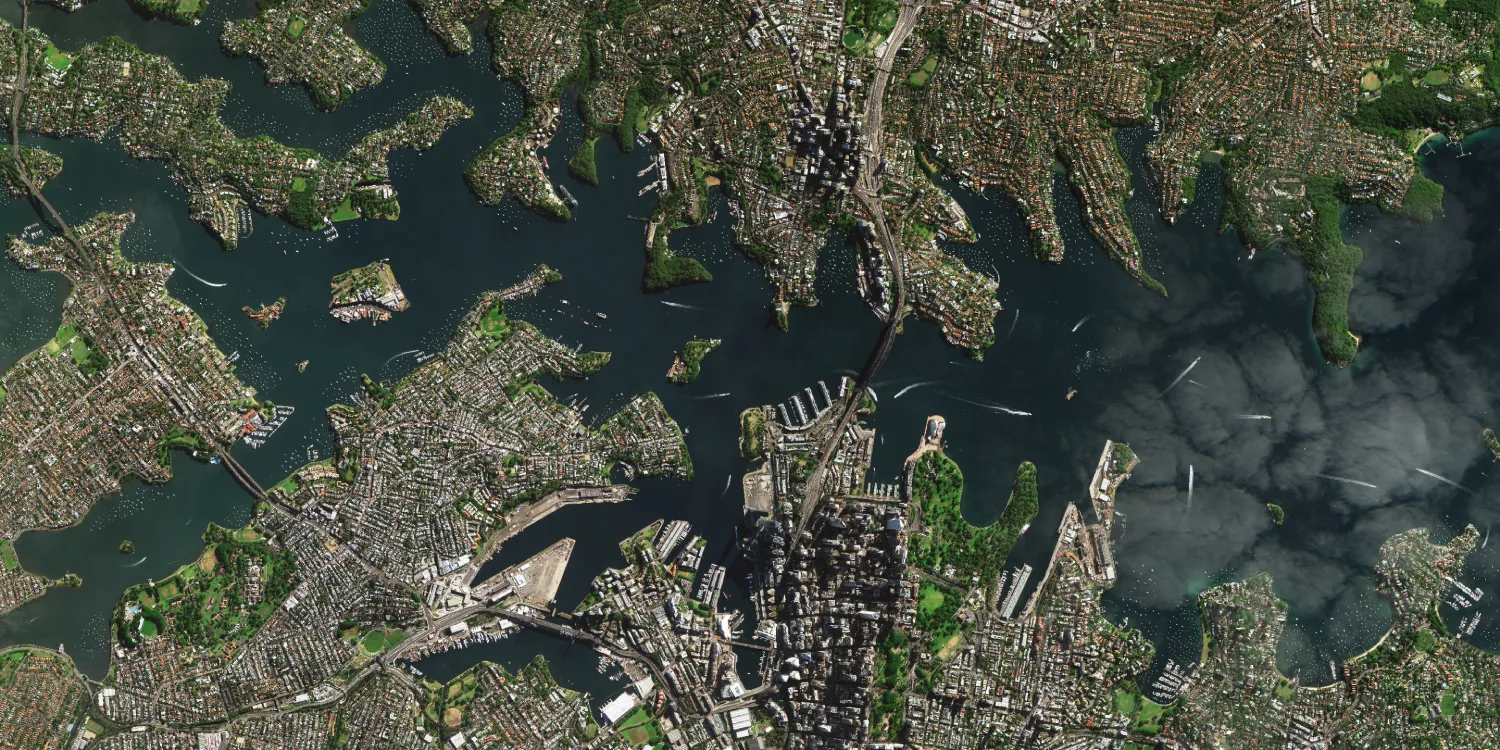
STAR.VISION OSE imagery is captured by the Oriental Smart Eye (OSE) multispectral satellites every 4 days anywhere on the globe. Catalog datasets are available starting from 2024.
-
STAR.VISION OSE Tasking Order now A non-integrated data product.
BAND COMBINATIONS
- 3-band: Pansharpened true color (RGB)
- 4-band: Pansharpened (RGB and NIR)
- Bundle: 1 panchromatic and 4 multispectral bands (RGB and NIR)
-
Level 1 Order now A non-integrated data product.
BAND COMBINATIONS
- Bundle: 1 panchromatic and 4 multispectral bands (RGB and NIR)
-
Level 2A Order now A non-integrated data product.
BAND COMBINATIONS
- 3-band: Pansharpened true color (RGB)
- 4-band: Pansharpened (RGB and NIR)
- Bundle: 1 panchromatic and 4 multispectral bands (RGB and NIR)
-
Level 3 Order now A non-integrated data product.
BAND COMBINATIONS
- 3-band: Pansharpened true color (RGB)
- 4-band: Pansharpened (RGB and NIR)
-
Level 4A Order now A non-integrated data product.
BAND COMBINATIONS
- 3-band: Pansharpened true color (RGB)
- 4-band: Pansharpened (RGB and NIR)
| Specification | Description |
|---|---|
| Provider | STAR.VISION |
| Collection type | Tasking from 800 credits per km2 Catalog from 400 credits per km2 |
| Product type | Multispectral |
| System type | Satellite |
| Specification | Description |
|---|---|
| Resolution | OSE-GF01
OSE-WH01
OSE-OL1
|
| Masks | Transparency |
| NoData value | 0 |
| Primary | Georectified | Orthorectified | |
|---|---|---|---|
| Basic |  | | |
| TOA | with RPC | with RPC |  * * |
| Surface reflectance | | | |
| Display | | | |
| Primary | Georectified | Orthorectified | |
|---|---|---|---|
| Basic | | | |
| TOA | Level 1 with RPC* | Level 2A with RPC* | Level 3* Level 4A* |
| Surface reflectance | | | |
| Display | | | |
*Upon request.
| Specification | Description |
|---|---|
| Acquisition mode | Mono |
| Tasking priority | Standard High |
| Orbit | OSE-GF01: Sun-synchronous, at 520 km OSE-WH01: Sun-synchronous, at 530 km OSE-OL01: Sun-synchronous, at 520 km |
| Number of satellites | 3 |
| Revisit rate | Every 4 days |
| Swath width | OSE-GF01: 12 km OSE-WH01: 10 km OSE-OL01: 8 km |
| Specification | Description |
|---|---|
| Spectral bands | OSE-GF01Panchromatic: 450–700 nm Multispectral:
OSE-WH01Panchromatic: 450–700 nm Multispectral:
OSE-OL1Panchromatic: 450–800 nm Multispectral:
|
| Specification | Description |
|---|---|
| Coordinate reference system | UTM-WGS84 |
| Positional accuracy | OSE-GF01: 10 m CE90 absolute OSE-WH01: 5 m CE90 absolute OSE-OL01: 10 m CE90 absolute |
| Specification | Description |
|---|---|
| Limitations | Input: AOI at least 5 km wide Cloud coverage, depending on the priority:
Output: AOI-clipped imagery |
| Minimum charge | As per 100 km2 |
| Specification | Description |
|---|---|
| Limitations | Input: AOI at least 5 km wide Availability: From 2024 Output: AOI-clipped imagery |
| Minimum charge | As per 25 km2 |
The geographic coverage is global.