Optical sensors can capture imagery in the form of multispectral or hyperspectral imagery. Multispectral imagery captures a small number of broad, discrete bands. In contrast, hyperspectral imagery consists of dozens of continuous, narrow bands.
Multispectral imagery
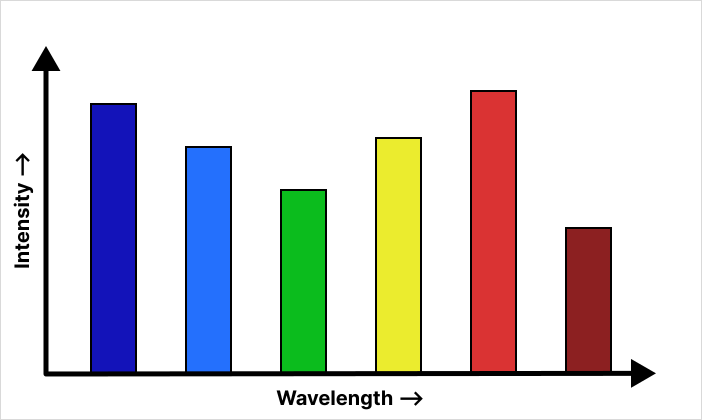
- Specific, discontinuous ranges of the spectrum with gaps between bands.
- Broader bandwidths of mostly 50–200 nm wide, with panchromatic bandwidths spanning 200–450 nm.
- Broadly identifies and classifies materials.
Hyperspectral imagery
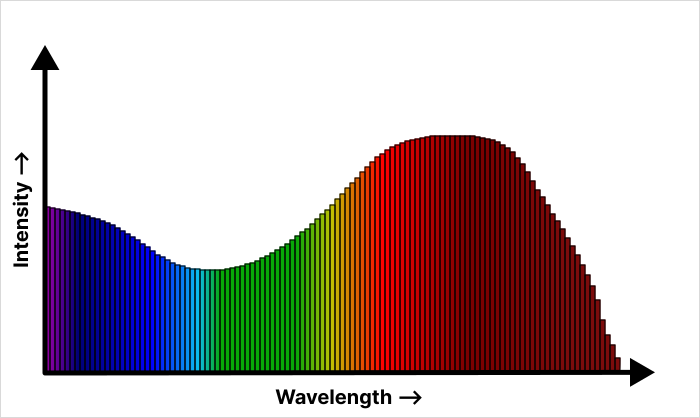
- Broader, continuous ranges of the spectrum with minimal to no gaps between bands.
- Narrower bandwidths of 5–20 nm wide.
- Isolates and identifies specific material spectral signatures.
Multispectral imagery
- Greater resolution for each band as it averages light captured over a broader range of wavelengths.
- Lower spectral resolution for each captured pixel.
Hyperspectral imagery
- Lower resolution for each band, as it captures light over a smaller range of wavelengths.
- Greater spectral resolution for each captured pixel.
All multispectral and hyperspectral imagery follow the standardized geometric and radiometric processing levels and delivery formats.
Multispectral imagery
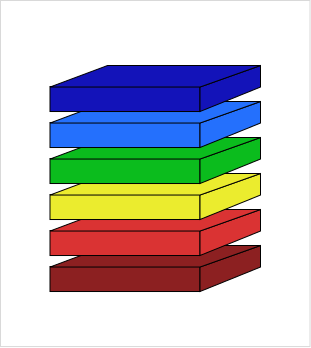
- Typically, four to six bands, with a relatively lower file size.
- More suited for visual analysis methods.
- Greater availability of catalog imagery.
- Relatively lower cost.
Hyperspectral imagery
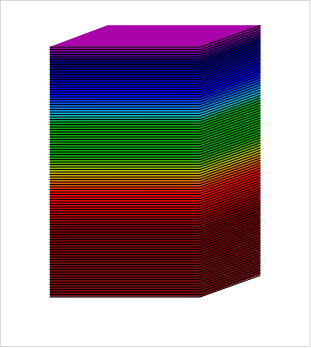
- Typically, dozens of spectral bands, with a relatively larger file size.
- Requires more advanced analysis tools.
- Lower availability of catalog imagery, often needs to be tasked.
- Relatively higher cost.
Multispectral and hyperspectral imagery are complementary and can be used for a variety of use cases.
| Field | Multispectral imagery | Hyperspectral imagery |
|---|---|---|
| Agriculture |
|
|
| Environmental monitoring |
|
|
| Mining and resource extraction |
|
|
| Utilities and vegetation management |
|
|